

Feature intelligence
Canonical Recognition Component
Recognize analytic curves and surfaces in NURBS CAD geometry with controlled tolerance. Integrate Canonical Recognition into OCCT applications.
On this page
Recognize analytic geometry in NURBS CAD models
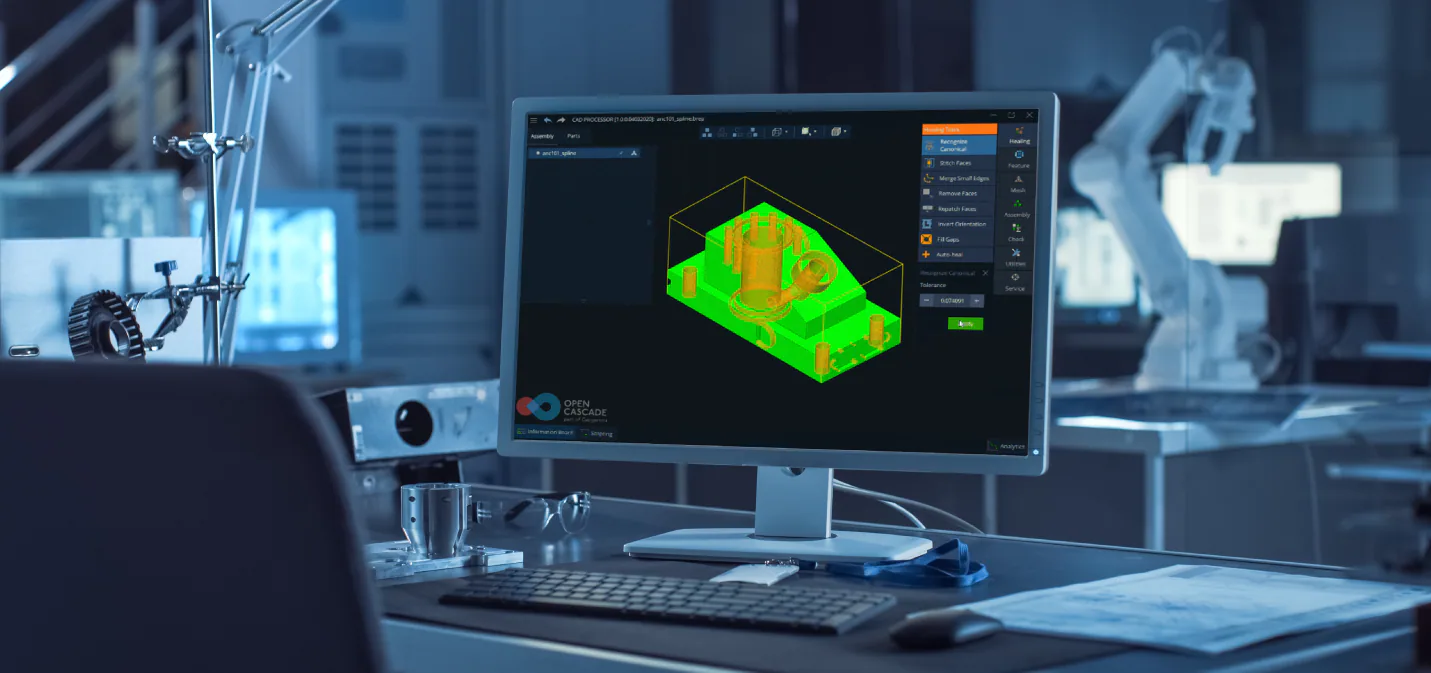
Canonical Recognition identifies curves and surfaces that can be represented analytically within a chosen tolerance. It can help simplify imported CAD geometry when planes, cylinders or other analytic forms have been represented as NURBS.
The component covers conversion of NURBS curves to lines, circles and ellipses, and surfaces to planes, cylinders, cones, spheres and tori. Its processing includes opportunities to merge compatible neighboring geometry while retaining the required topological structure.
NURBS-to-analytic conversion workflow
Start with imported OCCT shapes, choose the recognition tolerance, apply recognition and inspect the resulting geometry and topology. The tolerance determines which approximations are acceptable for the application.
Recognition of an analytic surface is distinct from recognition of a manufacturing feature. Identifying a cylinder does not by itself identify a drilled hole, establish its machining operation or reconstruct the original design history.
Supported curves, surfaces and tolerance controls
The input geometry can use B-spline or Bézier representations. Recognition replaces eligible geometry with the following analytic forms:
| Input | Recognized forms |
|---|---|
| 3D curves | Lines, circles and circular arcs, ellipses and elliptical arcs |
| Surfaces | Planes, cylinders, cones, spheres and tori |
Recognition and approximation use configurable tolerances. These settings let an application decide whether a near-analytic surface is close enough to the required form for its manufacturing or measurement workflow.
Merge compatible topology and track modifications
The component can combine adjacent edges or faces with compatible geometry into unified entities while preserving connectivity. It records a history of modifications so that an application can trace the relationship between source and processed entities.
Analytic geometry exposes useful properties directly: a cylinder has an axis and radius, a sphere has a center and radius, and a plane has a normal and equation. CAM and coordinate-measurement applications can use those properties when preparing operations. Intersections, projections and Boolean operations may also benefit from simpler representations; the effect should be measured for the actual workload.
Recognition can run automatically after a STEP, IGES or proprietary-format import, as a preparation stage before analysis, or as an explicit command in an application’s interface.
Validate the result downstream
Compare geometric deviation, shape validity and topology before and after processing. Check that the next operation, such as analysis, editing or exchange, accepts the simplified representation. Do not assume that fewer surface parameters guarantee faster processing for every operation.
Use the component with Parasolid import, ACIS exchange or another CAD reader. For a broader model preparation requirement, see CAD Simplification.
Discuss analytic recognition evaluation with representative geometry, the desired tolerance, OCCT release and downstream operation.