

Manufacturing
Unfolding Component
Calculate flat blanks from 3D sheet geometry with the Unfolding component. Evaluate deformation and accuracy for material preparation.

On this page
Develop a flat blank from a curved shell
The Unfolding component computes a planar representation of curved sheet geometry. It supports applications that prepare blanks for formed plates and other sheet-material products, with information about the deformation required to flatten the surface.
Developable and non-developable surfaces
A developable surface can be flattened by bending without in-plane distortion. A surface with non-zero Gaussian curvature generally also requires stretching or compression. This difference affects both the flat result and how useful that result is for production planning.
For non-developable geometry, the algorithm minimizes deformation energy to make the plate planar. Its published description identifies small distortions as the case where this approximation is most accurate. The result includes a deformation distribution that helps the application assess the flattening.
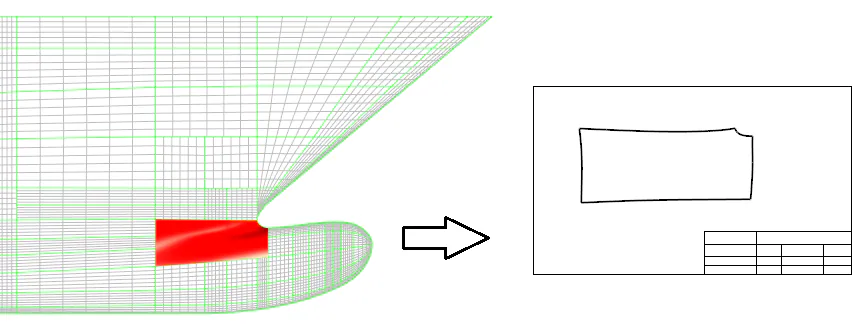
Map geometry and inspect strain
The component maps points and lines between the curved 3D plate and its unfolded 2D representation. Strain values can be evaluated at points on the plate, providing more information than an outline alone.
Mesh-generation parameters control the discretization used by the calculation. Compare the flat result and strain distribution as those parameters change, particularly around regions with stronger curvature. Results can be exported in PLY and VTK formats.
Integrate the result into material preparation
Identify the plate geometry, lines that must be transferred, and the deformation information required by the production workflow. Bend allowances, material behavior and machine-specific manufacturing rules are separate requirements to scope for the application; do not infer them from a flattening operation alone.
For CAD inputs, see the exchange catalog. For subsequent contour processing, explore CAM Library.
Discuss unfolding evaluation with representative shells and the accuracy and deformation criteria used to accept the blank.